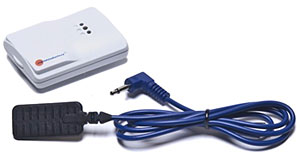
HEMOdialert with HEMOsensor for Haemodialysis

A reliable back-up device for detecting venous needle dislodgement during haemodialysis, providing an extra layer of safety for patients and healthcare providers.

Alarm Frequency
3.3kHz
Minimal Detection
1mL
Detection Time
1-2s
Certified
CE Mark

An easy-to-use alarm system

The HEMOdialert is designed to provide reliable protection against blood loss during dialysis, giving peace of mind to patients and healthcare providers.

HEMOdialert with HEMOsensor

A back-up device that detects venous needle dislodgement during haemodialysis, triggering in contact with conductive fluids including blood.

  • Detects blood leaks of less than 1mL in 1-2 seconds
  • Emits loud alarm at 3.3 kHz frequency
  • Reusable sensor with simple cleaning
  • Battery level indicators for safety
  • Includes spare sensor in package
HEMOdialert with HEMOsensor - Blood loss detection device for haemodialysis

How the HEMOdialert™ alarm works

The HEMOdialert™ alarm will detect a blood leak from the fistula site of less than 1mL in 1 to 2 seconds or less. It can also detect other body fluids such as perspiration.

The HEMOsensor™ is a unique, patented, injection moulded, plastic, reusable sensor. It is placed over the fistula site and taped in place. It is impervious to blood and other fluids and so can be reused after cleaning with alcohol or any proprietary antibacterial/antiviral cleaner (avoid bleach, this will damage the special plastic).

The HEMOdialert™ alarm responds to small amounts of blood on the HEMOsensor™, by emitting a loud alarm at approximately 3.3 kHz, a frequency that has been established as one to which the human ear is especially sensitive.

For additional safety, when the HEMOsensor™ is plugged into the alarm for use, the alarm beeps to indicate that the battery level is sufficient to power the circuit. If during use the battery power reduces below a predetermined level (this has been established with a high degree of safety with regard to battery power required to operate the alarm), then the alarm will beep at 10 second intervals to warn of the need to replace the batteries.

While the HEMOsensor™ is reusable, over time (e.g., after 6-9 months), the flexing of the wires may require it to be replaced. For this reason a spare sensor is supplied with the package.

Safety and Usability

The HEMOdialert™ has been tested for performance. In a clinical environment it meets electrical, mechanical and ergonomic safety requirements for the user, and conforms with electromagnetic compatibility. It is also designed for ease of use.

Full instructions come with the HEMOdialert™.

Order HEMOdialert - Haemodialysis Alarm

Each HEMOdialert™ packet contains:

  • 1x Alarm
  • 4LR44 6v Battery
  • 2x HEMOsensors™
  • 1x Instructions
HEMOdialert Device Package Contents

Pricing and Shipping Inquiries

Australia - Logikal Health Products:

024970533

UK - LINC Medical Systems:

01572 717515

New Zealand - Anzacare Limited:

0800-374-753

International - Anzacare Limited:

0064-4-212-5245

Manufacturer & Certifications

Manufacturer

Anzacare Ltd.
13 Tawa Place
Waikanae 5036, New Zealand
Phone: +64 4 212 5245
Email: info@hemodialert.com

Certifications

Europe: CE Mark

The HEMOdialert has been designed to meet the following standards:

  • UL International Report No 13870A 16 July 2008: Anzacare Body Fluid Detection Alarm with Reusable Plastic Sensor Model: HEMOdialert.
  • ISO 226:2003 Acoustics -- Normal equal-loudness-level contours
  • IEC/ EN 60601-1:2006 Medical Electrical equipment. Part 1: General requirements for basic safety and essential performance.
  • ISO 14971:2007 Medical devices - Application of risk management to medical devices
  • IEC/EN 60601-1-2: 2006 and 2007. Medical Electrical Equipment Part 1-2: General requirements for basic safety and essential performance - Collateral Standard: Electromagnetic compatibility - Requirements and tests.
  • IEC 60601-1-6: 2006 Medical electrical equipment - Part 1-6: General requirements for basic safety and essential performance - Collateral standard: Usability.

About HEMOdialert

Occasionally during haemodialysis the needle connecting the blood line from the dialysis machine may become disconnected from the fistula site. For example, this can happen if a patient who suffers from restlessness, dementia or mental illness deliberately or accidentally removes it from the vascular access.

This can result in blood loss from the patient. While the dialysis machine itself may detect a line disconnect due to a pressure drop and trigger an alarm, these alarms are not always reliable. And, if the clinical staff are also unaware that a line disconnect has occurred then a back-up alert for a possible blood leak at the fistula site may be appropriate.

Q

What is Venous Needle Dislodgement (VND)?

Venous needle dislodgement (VND) occurs when the needle connecting the blood line from the dialysis machine becomes disconnected from the fistula site during haemodialysis, which can lead to significant blood loss.

A

How HEMOdialert Helps

HEMOdialert™ provides a reliable back-up system that detects blood leaks at the fistula site in 1-2 seconds, emitting a loud alarm at approximately 3.3 kHz to alert healthcare providers to take immediate action.

Protect patients against Venous Needle Dislodgement

Contact us today to learn more about HEMOdialert™ and how it can provide an additional layer of safety during haemodialysis treatments.